Predictions & Data for this entry
| Model: std | climate: MA | migrate: Ma | phylum: |
| COMPLETE = 2.5 | ecozone: MPW, MIN | food: biCim | class: |
| MRE = 0.041 | habitat: 0iMcd | gender: D | order: |
| SMSE = 0.003 | embryo: Mv | reprod: O | family: |
Zero-variate data
| Data | Observed | Predicted | (RE) | Unit | Description | Reference |
|---|---|---|---|---|---|---|
| ab | 330 | 325.6 | (0.01319) | d | age at birth | guess |
| am | 6935 | 6932 | (0.0004061) | d | life span | YamaKawa2005 |
| Lb | 32 | 26.33 | (0.1771) | cm | disc width at birth | YamaKawa2005 |
| Lp | 74.6 | 74.41 | (0.002539) | cm | disc width at puberty | WhitMoor2013 |
| Lpm | 50 | 50.03 | (0.0005788) | cm | disc width at puberty | WhitMoor2013 |
| Li | 90 | 93.25 | (0.03614) | cm | ultimate disc width | WhitMoor2013 |
| Wwi | 1.39e+04 | 1.379e+04 | (0.008273) | g | wet weight at disc width 72 cm | fishbase |
| Ri | 0.01096 | 0.01094 | (0.001762) | #/d | maximum reprod rate | fishbase |
Uni- and bivariate data
| Data | Figure | Independent variable | Dependent variable | (RE) | Reference |
|---|---|---|---|---|---|
| tL_f | 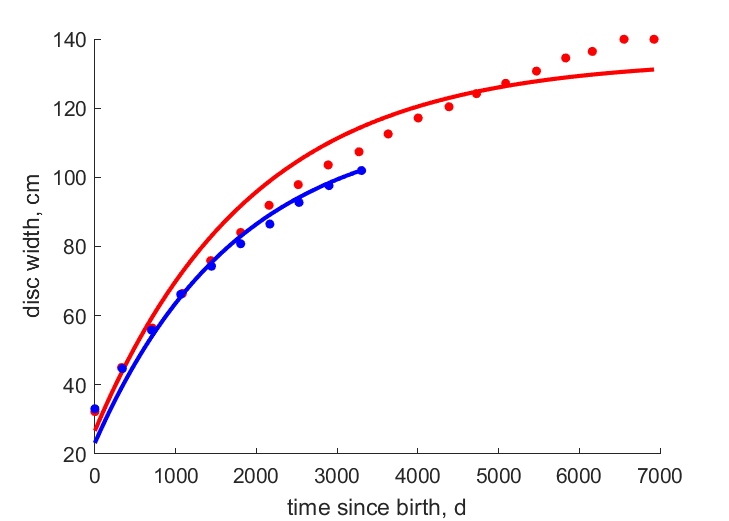  | time since birth | disc width | (0.05025) | YamaKawa2005 |
| tL_m | | time since birth | disc width | (0.02368) | YamaKawa2005 |
Pseudo-data at Tref = 20°C
| Data | Generalised animal | Aetobatus flagellum | Unit | Description |
|---|---|---|---|---|
| v | 0.02 | 0.02793 | cm/d | energy conductance |
| p_M | 18 | 14.22 | J/d.cm^3 | vol-spec som maint |
| k_J | 0.002 | 0.002 | 1/d | maturity maint rate coefficient |
| k | 0.3 | 0.7365 | - | maintenance ratio |
| kap | 0.8 | 0.6914 | - | allocation fraction to soma |
| kap_G | 0.8 | 0.7988 | - | growth efficiency |
| kap_R | 0.95 | 0.95 | - | reproduction efficiency |
Discussion
- The cost for milk secretion is added to the investment from the reproduction buffer.
- Males are supposed to differ from females by {p_Am} and E_Hp only
- DW in tL data are much larger than max DW of 72 cm given by fishbase. confusion with Aetobatus narinari?
- mod_1: males have equal state variables at b, compared to females
Facts
- At first, they are enclosed in an egg case while the developing embryos feed on the yolk. After the egg hatches, the pup remains in the oviduct and receives nourishment from a milky secretion (Ref: fishbase)
Bibliography