Predictions & Data for this entry
| Model: std | climate: Dfa, Cfb | migrate: | phylum: |
| COMPLETE = 2.6 | ecozone: THn | food: biCi, biCvf | class: |
| MRE = 0.071 | habitat: 0iFm | gender: D | order: |
| SMSE = 0.011 | embryo: Fh | reprod: O | family: |
Zero-variate data
| Data | Observed | Predicted | (RE) | Unit | Description | Reference |
|---|---|---|---|---|---|---|
| ah | 9 | 9.121 | (0.0134) | d | age at hatch | flmnh |
| ab | 18 | 15.55 | (0.1363) | d | age at birth | flmnh |
| ap | 1095 | 1257 | (0.148) | d | age at puberty | EtniStar1993 |
| am | 4380 | 4397 | (0.003924) | d | life span | ADW |
| Lh | 0.8 | 0.7896 | (0.01297) | cm | total length at hatch | flmnh |
| Lb | 1.2 | 1.309 | (0.09047) | cm | total length at birth | flmnh |
| L365 | 20.3 | 19.41 | (0.04408) | cm | total length at 365d | flmnh |
| Lp | 60 | 47.11 | (0.2148) | cm | total length at puberty | ADW |
| Li | 75 | 77.6 | (0.0347) | cm | ultimate total length | flmnh |
| Wwi | 3800 | 3899 | (0.02599) | g | ultimate wet weight | flmnh |
| Ri | 175.3 | 172.7 | (0.01518) | #/d | maximum reprod rate | flmnh |
Uni- and bivariate data
| Data | Figure | Independent variable | Dependent variable | (RE) | Reference |
|---|---|---|---|---|---|
| LW | 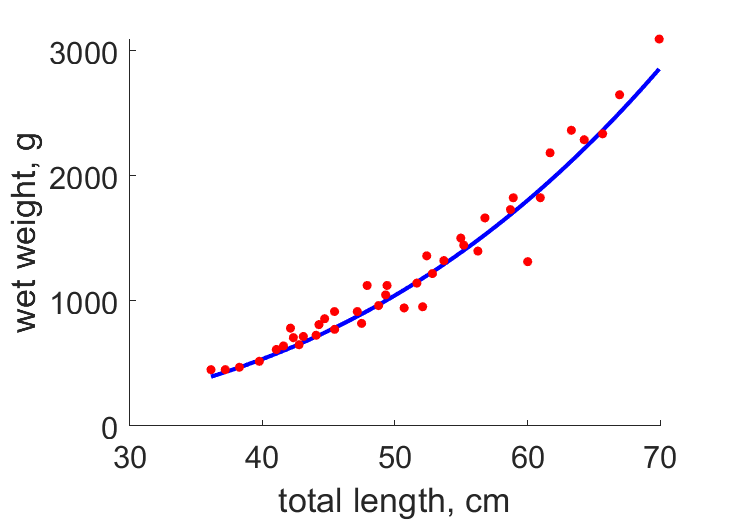 | total length | wet weight | (0.07719) | Virfish |
| tL | 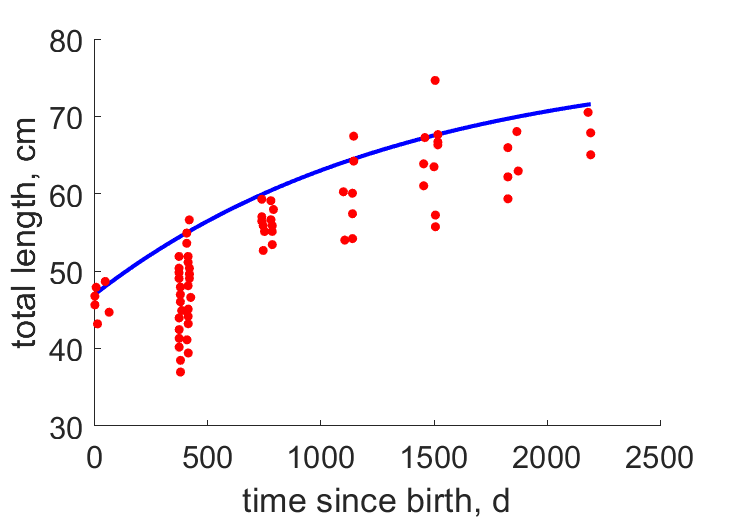 | time since birth | total length | (0.1082) | Virfish |
Pseudo-data at Tref = 20°C
| Data | Generalised animal | Amia calva | Unit | Description |
|---|---|---|---|---|
| v | 0.02 | 0.02561 | cm/d | energy conductance |
| kap | 0.8 | 0.5637 | - | allocation fraction to soma |
| kap_R | 0.95 | 0.95 | - | reproduction efficiency |
| p_M | 18 | 154 | J/d.cm^3 | vol-spec som maint |
| k_J | 0.002 | 0.002 | 1/d | maturity maint rate coefficient |
| kap_G | 0.8 | 0.8014 | - | growth efficiency |
Facts
- air breather at >18C (Ref: flmnh)
- bowfin is host to glochidia larvae of the mollusk Megalonaias gigantea. (Ref: flmnh)
- After fertilization, the eggs develop within the gill tubes into the tiny glochidia larvae. (Ref: flmnh)
- The hatchlings have an adhesive organ on the tip of their snout that attaches them to the nest. (Ref: flmnh)
Bibliography