Predictions & Data for this entry
| Model: stx | climate: MC | migrate: | phylum: |
| COMPLETE = 2.5 | ecozone: MS | food: bxM, xiCvf, xiCic, xiCik | class: |
| MRE = 0.050 | habitat: 0iMc | gender: Dg | order: |
| SMSE = 0.007 | embryo: Tv | reprod: O | family: |
Zero-variate data
| Data | Observed | Predicted | (RE) | Unit | Description | Reference |
|---|---|---|---|---|---|---|
| tg | 257 | 267.9 | (0.04222) | d | gestation time | AnAge |
| tx | 112 | 112 | (9.202e-05) | d | time since birth at weaning | AnAge |
| tp | 1278 | 1248 | (0.02332) | d | time since birth at puberty | AnAge |
| tpm | 1278 | 1368 | (0.07046) | d | time since birth at puberty | AnAge |
| am | 1.117e+04 | 1.117e+04 | (6.391e-05) | d | life span | AnAge |
| Wwb | 4200 | 4159 | (0.00982) | g | wet weight at birth | AnAge |
| Wwi | 3.5e+04 | 3.624e+04 | (0.03556) | g | ultimate wet weight for females | AnAge |
| Wwim | 2e+05 | 1.826e+05 | (0.08702) | g | ultimate wet weight for males | Wiki |
| Ri | 0.00274 | 0.002689 | (0.01854) | #/d | maximum reprod rate | AnAge |
Uni- and bivariate data
| Data | Figure | Independent variable | Dependent variable | (RE) | Reference |
|---|---|---|---|---|---|
| tW_f | 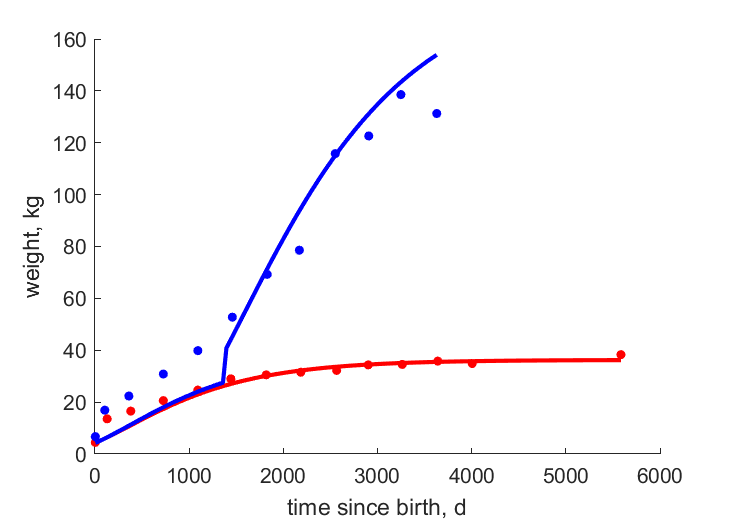  | time since birth | weight | (0.0689) | Payn1979 |
| tW_m | | time since birth | weight | (0.1394) | Payn1979 |
| tW | 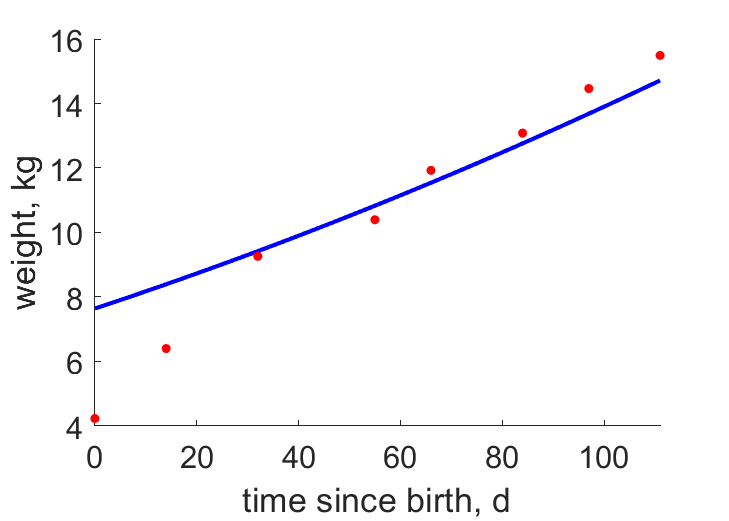 | time since birth | weight | (0.09696) | Kerl1985 |
Pseudo-data at Tref = 20°C
| Data | Generalised animal | Arctocephalus gazella | Unit | Description |
|---|---|---|---|---|
| v | 0.02 | 0.02347 | cm/d | energy conductance |
| kap | 0.8 | 0.6047 | - | allocation fraction to soma |
| kap_R | 0.95 | 0.95 | - | reproduction efficiency |
| p_M | 18 | 17.04 | J/d.cm^3 | vol-spec som maint |
| k_J | 0.002 | 0.002 | 1/d | maturity maint rate coefficient |
| kap_G | 0.8 | 0.7998 | - | growth efficiency |
Discussion
- Males are assumed to differ from females by {p_Am} and E_Hp only
- Male {p_Am} jumps upward at puberty, as discussed in Kooy2014 under type A acceleration
- mod_1: males have equal state variables at b, compared to females
Acknowledgment
- The creation of this entry was supported by the Norwegian Science Council (NFR 255295)
Bibliography