Predictions & Data for this entry
| Model: abj | climate: MA | migrate: | phylum: |
| COMPLETE = 2.3 | ecozone: MPSW | food: biTvf | class: |
| MRE = 0.071 | habitat: 0iMd | gender: Hh | order: |
| SMSE = 0.010 | embryo: Mc | reprod: O | family: |
Zero-variate data
| Data | Observed | Predicted | (RE) | Unit | Description | Reference |
|---|---|---|---|---|---|---|
| ab | 9 | 8.525 | (0.05273) | d | age at birth | GlenChis2007 |
| tp | 91 | 86.29 | (0.05181) | d | time since birth at puberty | GlenChis2007 |
| am | 182.5 | 181.5 | (0.005368) | d | life span | guess |
| Lb | 0.014 | 0.01326 | (0.05306) | cm | total length at birth | GlenChis2007 |
| Lp | 0.537 | 0.5377 | (0.001223) | cm | total length at puberty | GlenChis2007 |
| Li | 0.6627 | 0.6576 | (0.007649) | cm | ultimate total length | GlenChis2005 |
| Wwb | 2.3e-13 | 2.092e-08 | (9.093e+04) | g | wet weight at birth | GlenChis2007 |
| Wwp | 0.0013 | 0.001395 | (0.0732) | g | wet weight at puberty | GlenChis2007 |
| Wwi | 0.0026 | 0.002553 | (0.01807) | g | ultimate wet weight | GlenChis2007 |
| Ri | 27.4 | 27.34 | (0.002203) | #/d | maximum reprod rate | guess |
Uni- and bivariate data
| Data | Figure | Independent variable | Dependent variable | (RE) | Reference |
|---|---|---|---|---|---|
| tL | 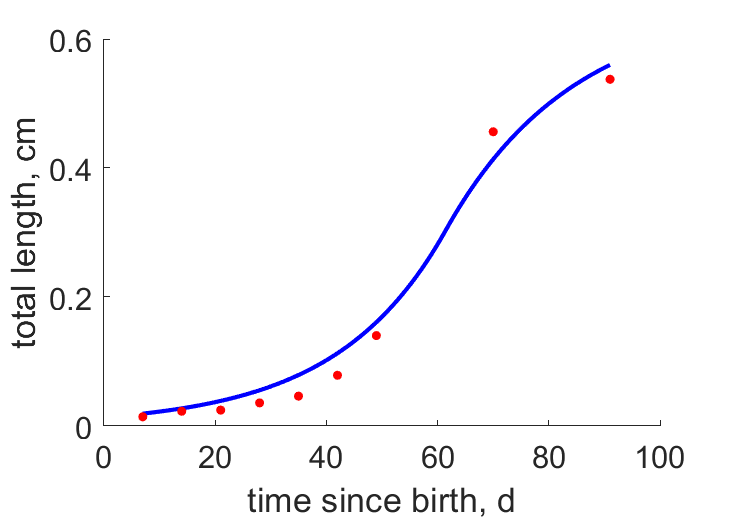 | time since birth | total length | (0.1448) | GlenChis2007 |
Pseudo-data at Tref = 20°C
| Data | Generalised animal | Branchotenthes octohamatus | Unit | Description |
|---|---|---|---|---|
| v | 0.02 | 0.0004011 | cm/d | energy conductance |
| kap | 0.8 | 0.9947 | - | allocation fraction to soma |
| kap_R | 0.95 | 0.475 | - | reproduction efficiency |
| p_M | 18 | 21.3 | J/d.cm^3 | vol-spec som maint |
| k_J | 0.002 | 0.002 | 1/d | maturity maint rate coefficient |
| kap_G | 0.8 | 0.8011 | - | growth efficiency |
Discussion
- Hermaphroditic, so kap_R is halved
- The very low energy conductance that was found is due to long incubation time, which might include a torpor period
Facts
- Hatching is induced by agitation (Ref: GlenChis2007)
- Hexabothriidae includes polyopisthocotylean monogeneans exclusively parasitic on the gills of chondrichthyan fishes (Ref: GlenChis2005)
Bibliography