Predictions & Data for this entry
| Model: std | climate: MA, MB | migrate: Mo | phylum: |
| COMPLETE = 3.0 | ecozone: MC | food: biCij | class: |
| MRE = 0.122 | habitat: 0bTd, biMp | gender: Dtmf | order: |
| SMSE = 0.041 | embryo: Tt | reprod: O | family: |
Zero-variate data
| Data | Observed | Predicted | (RE) | Unit | Description | Reference |
|---|---|---|---|---|---|---|
| ab | 63 | 52.85 | (0.1612) | d | age at birth | ESA2020 |
| ap | 19.25 | 15.53 | (0.193) | yr | age at puberty | ESA2020 |
| am | 1.104e+04 | 1.095e+04 | (0.008537) | d | life span | ESA2020 |
| Lb | 6.18 | 5.651 | (0.08558) | cm | length at birth, SCL | Wyne2023 |
| Lp | 125.6 | 131.7 | (0.04878) | cm | length at puberty, SCL | AvenTayl2009 |
| Li | 151.1 | 133.6 | (0.1153) | cm | ultimate length, SCL | AvenGosh2020, ESA2020, ZugParh1996 |
| Ww0 | 83.59 | 54.9 | (0.3432) | g | initial wet weight | Hsu2020, Thom1993 |
| Wwb | 46.03 | 45.48 | (0.01194) | g | wet weight at birth | Hsu2020, Wyne2023, Thom1993 |
| Wdb | 9.776 | 13.64 | (0.3957) | g | dry weight at birth | Thom1993 |
| Wwi | 3.7e+05 | 4.395e+05 | (0.1879) | g | ultimate wet weight | Wood1982, PalaSot1996, LutcBush1992 |
| Ri | 0.4147 | 0.4094 | (0.01277) | #/d | ultimate reproduction rate | ESA2020 |
| pAm | 0.41 | 0.2263 | (0.4481) | W/kg | mass-specific metabolic rate | Jone2009 |
| pXm | 1.13 | 0.8115 | (0.2818) | W/kg | maximum intake of jellyfish of fully grown individual | Jone2009 |
Uni- and bivariate data
| Data | Figure | Independent variable | Dependent variable | (RE) | Reference |
|---|---|---|---|---|---|
| tL_Jone | 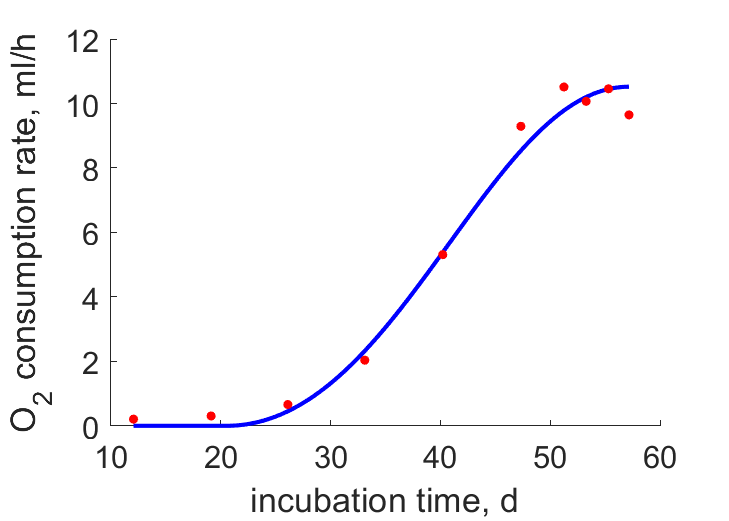  | time since birth | straight carapace length, from Jones | (0.04547) | Jone2009 |
| tL_cap | | time since birth | straight carapace length, from Jones | (0.1804) | Jone2009 |
| tW_Jone | 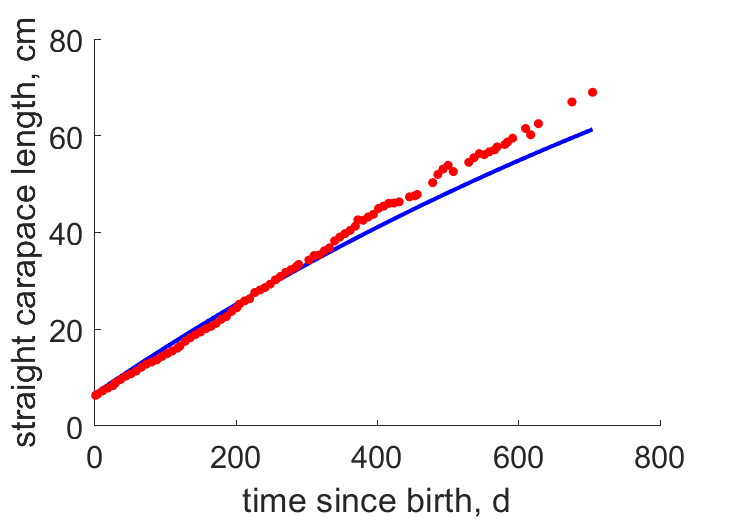  | time since birth | wet weight, from Jones | (0.0796) | Jone2009 |
| tW_cap | | time since birth | wet weight, from Jones | (0.276) | Jone2009 |
| LW_Jone | 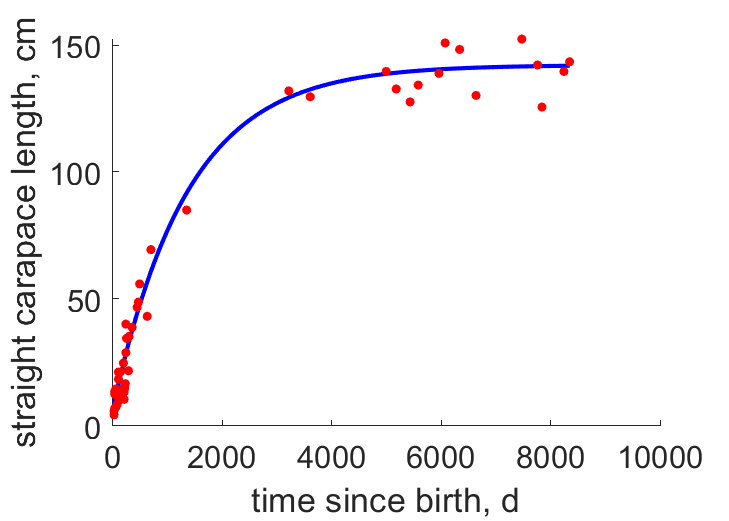  | straight carapace length | wet weight, from Jones | (0.1608) | Jone2009 |
| LW_cap | | straight carapace length | wet weight, from Jones | (0.343) | Jone2009 |
| LW_wild | | straight carapace length | wet weight, from Jones | (0.6107) | Jone2009 |
| tL_Wyne | 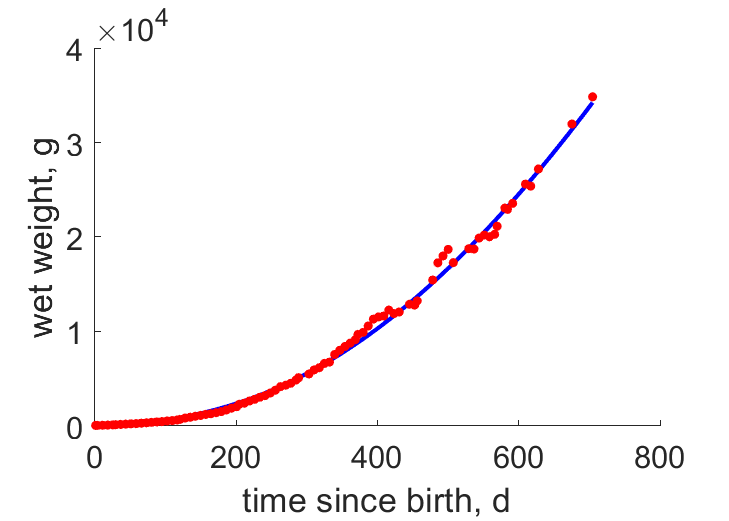  | time since birth | straight carapace length | (0.05955) | Wyne2023 |
| tL_Wyne09 | | time since birth | straight carapace length | (0.05555) | Wyne2023 |
| tL_Wyne13 | | time since birth | straight carapace length | (0.06212) | Wyne2023 |
| tL_Wyne14 | | time since birth | straight carapace length | (0.09031) | Wyne2023 |
| tW_Wyne | 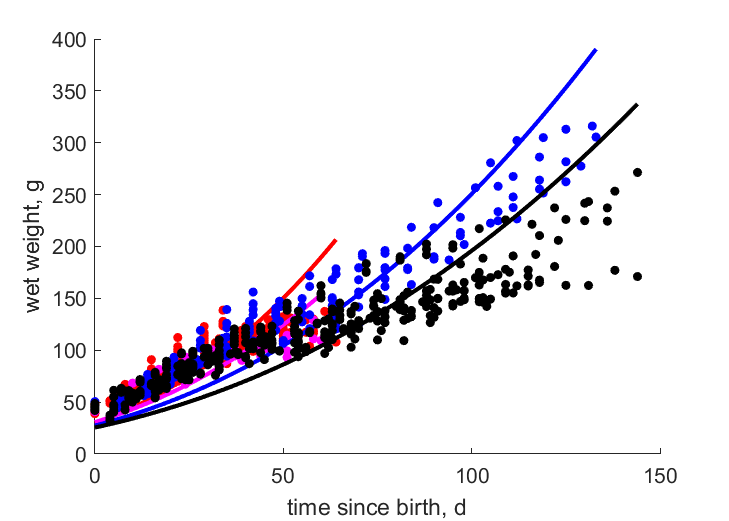 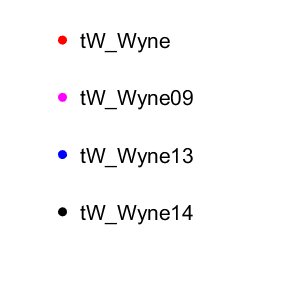 | time since birth | wet weight | (0.2069) | Wyne2023 |
| tW_Wyne09 | | time since birth | wet weight | (0.1789) | Wyne2023 |
| tW_Wyne13 | | time since birth | wet weight | (0.206) | Wyne2023 |
| tW_Wyne14 | | time since birth | wet weight | (0.2677) | Wyne2023 |
| LW_Wyne | 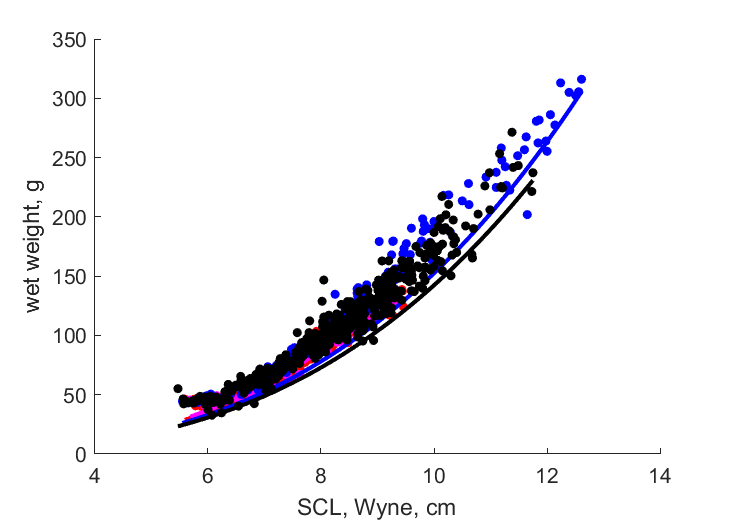 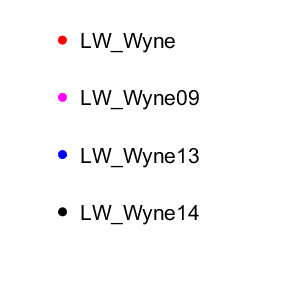 | SCL, Wyne | wet weight | (0.08045) | Wyne2023 |
| LW_Wyne09 | | SCL, Wyne | wet weight | (0.06239) | Wyne2023 |
| LW_Wyne13 | | SCL, Wyne | wet weight | (0.1726) | Wyne2023 |
| LW_Wyne14 | | SCL, Wyne | wet weight | (0.2107) | Wyne2023 |
| LN | 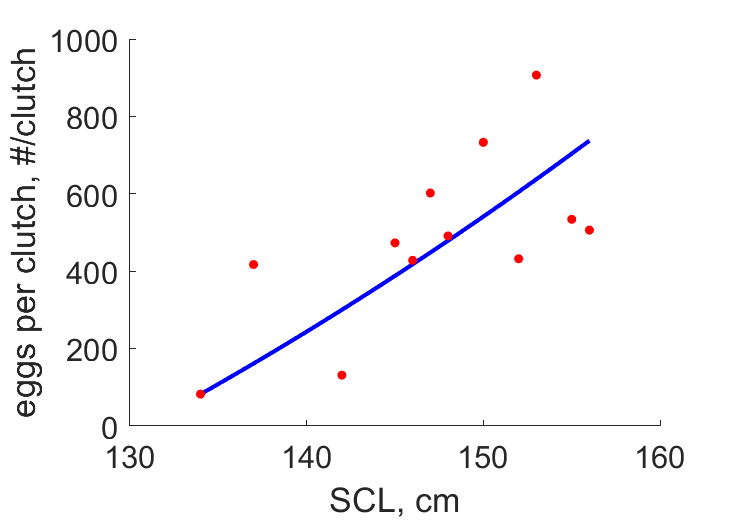 | SCL | eggs per clutch | (0.3004) | Hirt1987, TuckFraz1991 |
| tJO_e | 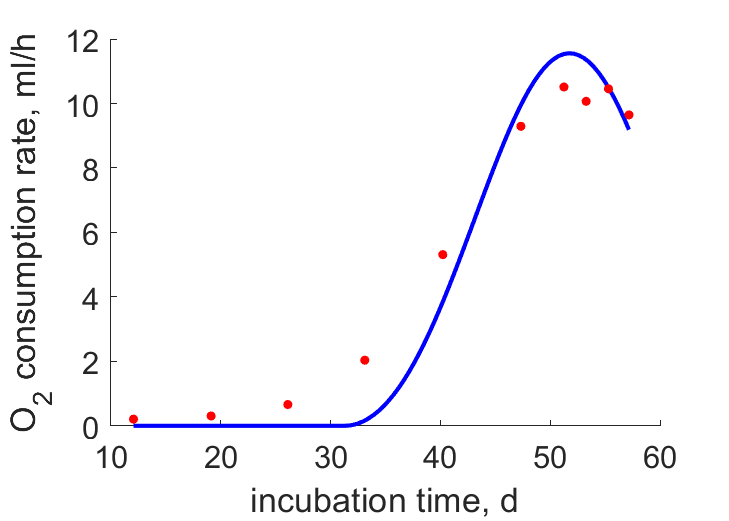 | incubation time | O_2 consumption rate | (0.1365) | Thom1993 |
| tL_skel | 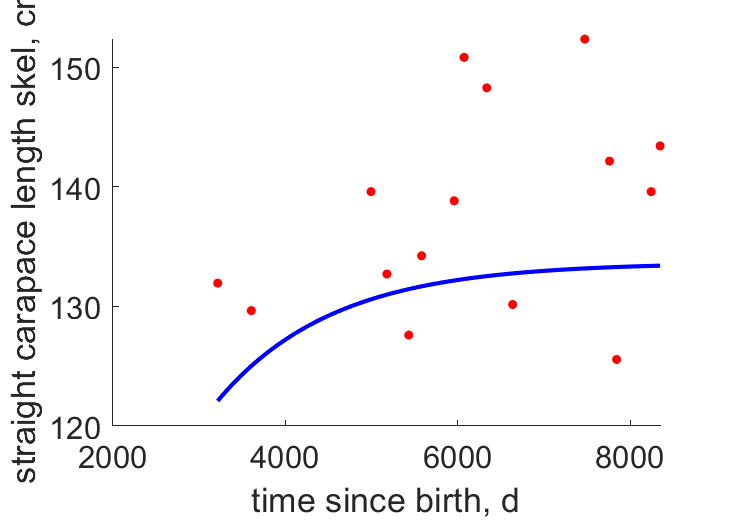 | time since birth | straight carapace length skel | (0.06154) | Jone2009 |
Pseudo-data at Tref = 20°C
| Data | Generalised animal | Dermochelys coriacea | Unit | Description |
|---|---|---|---|---|
| v | 0.02 | 0.139 | cm/d | energy conductance |
| p_M | 18 | 47.06 | J/d.cm^3 | vol-spec som maint |
| k_J | 0.002 | 0.002 | 1/d | maturity maint rate coefficient |
| k | 0.3 | 0.332 | - | maintenance ratio |
| kap | 0.8 | 0.6349 | - | allocation fraction to soma |
| kap_G | 0.8 | 0.8034 | - | growth efficiency |
| kap_R | 0.95 | 0.95 | - | reproduction efficiency |
| s_s | 0.01 | 0.1013 | - | supply stress |
Discussion
- Jone2009: 1.3e11 g jellyfish converts to 2.6e13 J, so jellyfish have 200 J/g
- mod_1: data on ingestion/metam revised, tJO_e, Ww0, Wdb data added
- mod_1: pAm was ignorned because of inconsistency with other data and because allometric correction was applied for obtaining the specific rate
- mod_1: Ww0 was ignorned because it needs detailed modelling of the contribution of water to weight
- mod_2: We use data from Jones 2009 (Tables 3.1, 3.2 and 3.3, combined with data from Zug et al (1986) presented in figure 3.2) for parameter estimation.Data from Table 3.1 used partially (where N>3), and tL1 data in the original entry had mixed captive and wild turtles- now revised
- mod_2: f for the wild assumed less than maximum (f=0.9) and applied for all calculations pertaining to wild turtles. This enables simulating f<1 for environmental scenarios
- mod_2: removed d_V = d_E = 0.22 as no reference was provided; re-estimated all parameters to be more in line with other sea turtle parameters,including kappa closer to 0.8 instead of 0.2, and z>55 as this is the largest species
- mod_2: Added data on growth sourced from captive rearing, courtesy of J. Wyneken
- mod_2: Linked publication: Ortega, Wyneken, Mitchell, Shillinger, Marn: Food, Glorious Food! Energy budget and reproductive potential of critically endangered leatherback turtles explored with mechanistic modeling, Marine Environmental Research
- Partial endothermy is not being explicitly modelled, but larger leatherback are capable of sustaining body temperature several degrees higher relative to ambient temperature.
Facts
- all 7 species of sea turtles nest on beaches; females lay up to 7 clutches at 10 - 14 d intervals. interbrood interval 2 - 8 yrs; males might return each yr. Feeding starts 5-11 d after hatching (Ref: Jone2009)
- feeds on gelatinous zooplankton, mostly jellyfish: Aurelia, Chrysaora, Cyanea, Rhizostoma, Stomolophus (Ref: Wiki)
Bibliography