Predictions & Data for this entry
| Model: std | climate: Cfa, Cwa, Dfa | migrate: | phylum: |
| COMPLETE = 2.4 | ecozone: THn | food: biCi | class: |
| MRE = 0.054 | habitat: 0jFp, jiTf, jiTg | gender: Dg | order: |
| SMSE = 0.009 | embryo: Fpf | reprod: O | family: |
Zero-variate data
| Data | Observed | Predicted | (RE) | Unit | Description | Reference |
|---|---|---|---|---|---|---|
| tp | 912.5 | 906.2 | (0.006877) | d | time since birth at puberty | KhonMats2014 |
| tpm | 547.5 | 547.1 | (0.0007385) | d | time since birth at puberty for males | KhonMats2014 |
| am | 1825 | 1825 | (8.077e-05) | d | life span | KhonMats2014 |
| Lj | 1.36 | 1.36 | (9.75e-05) | cm | SVL at metam | guess |
| Lp | 3.6 | 3.631 | (0.0085) | cm | SVL at puberty for females | KhonMats2014 |
| Li | 5.9 | 5.868 | (0.00536) | cm | ultimate SVL for females | KhonMats2014 |
| Lim | 4.8 | 5.022 | (0.04626) | cm | ultimate SVL for males | KhonMats2014 |
| Wwb | 0.0141 | 0.01414 | (0.002805) | g | wet weight at birth | guess |
| Wwi | 15.1 | 14.92 | (0.01161) | g | ultimate wet weight for females | guess |
| Ri | 0.5479 | 0.5454 | (0.004671) | #/d | maximum reprod rate | guess |
Uni- and bivariate data
| Data | Figure | Independent variable | Dependent variable | (RE) | Reference |
|---|---|---|---|---|---|
| tL_f | 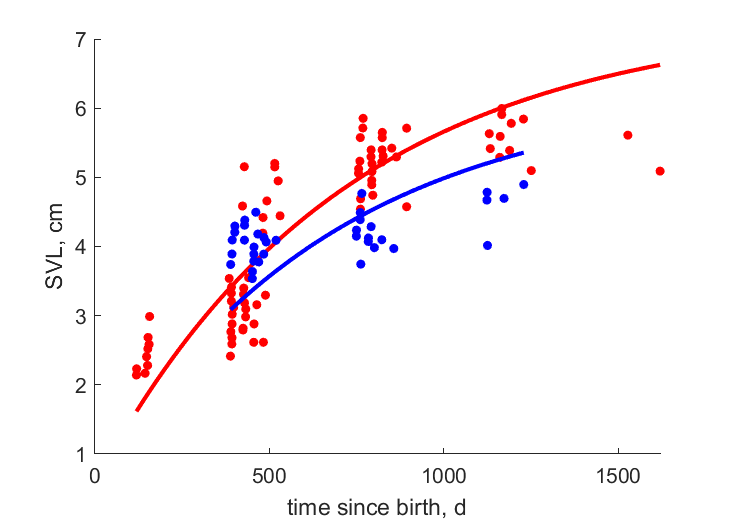 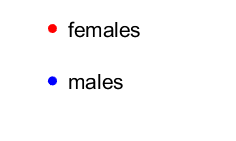 | time since birth | SVL | (0.1233) | KhonMats2014 |
| tL_m | | time since birth | SVL | (0.1382) | KhonMats2014 |
Pseudo-data at Tref = 20°C
| Data | Generalised animal | Glandirana rugosa | Unit | Description |
|---|---|---|---|---|
| v | 0.02 | 0.02535 | cm/d | energy conductance |
| kap | 0.8 | 0.773 | - | allocation fraction to soma |
| kap_R | 0.95 | 0.95 | - | reproduction efficiency |
| p_M | 18 | 52.47 | J/d.cm^3 | vol-spec som maint |
| k_J | 0.002 | 0.002 | 1/d | maturity maint rate coefficient |
| kap_G | 0.8 | 0.8018 | - | growth efficiency |
Discussion
- Males are assumed to differ from females by {p_Am} and E_Hp only
- mod_1: males have equal state variables at b, compared to females
Facts
- Tadpoles have an abdominal sucker, and adaptation to living in fast-flowing streams (Ref: amphibiaweb)
Bibliography