Predictions & Data for this entry
| Model: stx | climate: Aw, BSh | migrate: TW | phylum: |
| COMPLETE = 2.7 | ecozone: TPam | food: bxM, xiCii | class: |
| MRE = 0.027 | habitat: 0iTf | gender: Dg | order: |
| SMSE = 0.002 | embryo: Tv | reprod: O | family: |
Zero-variate data
| Data | Observed | Predicted | (RE) | Unit | Description | Reference |
|---|---|---|---|---|---|---|
| tg | 61 | 60.71 | (0.004785) | d | gestation time | AnAge |
| tx | 37 | 34.93 | (0.05605) | d | time since birth at weaning | AnAge |
| tp | 243 | 237 | (0.02471) | d | time since birth at puberty | AnAge |
| am | 3340 | 3366 | (0.007832) | d | life span | AnAge |
| Li | 13 | 13.03 | (0.002565) | cm | ultimate body length | Wiki |
| Wwb | 6 | 5.77 | (0.03834) | g | wet weight at birth | AnAge |
| Wwx | 28 | 29.83 | (0.06547) | g | wet weight at weaning | guess |
| Wwi | 82.7 | 82.25 | (0.005434) | g | ultimate wet weight | WhitSeym2003 |
| Ri | 0.0137 | 0.01351 | (0.01358) | #/d | maximum reprod rate | AnAge |
| JOi | 82.7 | 85.43 | (0.03299) | ml O2/h | max BMR | GenoIsle2018 |
Uni- and bivariate data
| Data | Figure | Independent variable | Dependent variable | (RE) | Reference |
|---|---|---|---|---|---|
| tL | 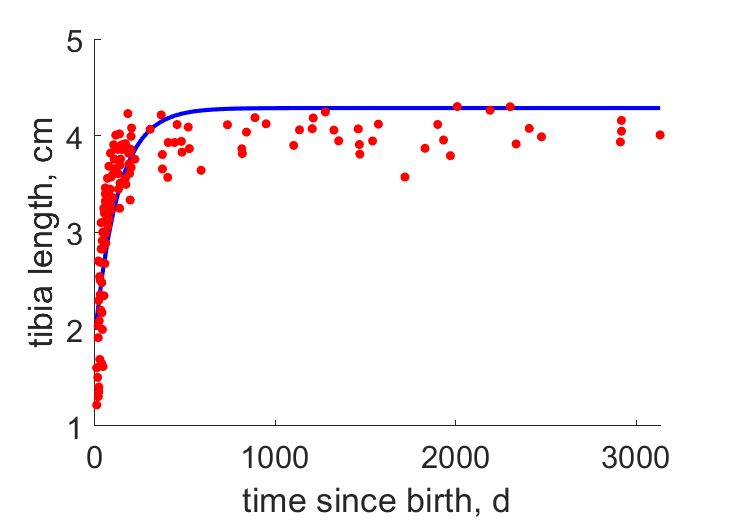 | time since birth | tibia length | (0.07427) | CastCroc2004 |
Pseudo-data at Tref = 20°C
| Data | Generalised animal | Microcebus murinus | Unit | Description |
|---|---|---|---|---|
| v | 0.02 | 0.0341 | cm/d | energy conductance |
| p_M | 18 | 677.5 | J/d.cm^3 | vol-spec som maint |
| k_J | 0.002 | 0.002 | 1/d | maturity maint rate coefficient |
| k | 0.3 | 0.02315 | - | maintenance ratio |
| kap | 0.8 | 0.9058 | - | allocation fraction to soma |
| kap_G | 0.8 | 0.8005 | - | growth efficiency |
| kap_R | 0.95 | 0.95 | - | reproduction efficiency |
| s_s | 0.01 | 0.05986 | - | supply stress |
| t_0 | 0 | 43.7 | d | time at start development |
Discussion
- mod_1: respiration data added, v reduced, Wwi updated
Facts
- body temp during topor 7C (= ambient in May-August). Females hibernate longer than males (Ref: Wiki)
- body temp can easily drop in response to starvation (Ref: GeniPerr2003)
Bibliography