Predictions & Data for this entry
| Model: std | climate: A, B | migrate: | phylum: |
| COMPLETE = 2.5 | ecozone: TN | food: biCvf | class: |
| MRE = 0.030 | habitat: 0xMc, 0xFm | gender: Dg | order: |
| SMSE = 0.004 | embryo: Tnpfm, Tncfm | reprod: O | family: |
Zero-variate data
| Data | Observed | Predicted | (RE) | Unit | Description | Reference |
|---|---|---|---|---|---|---|
| ab | 26 | 27.08 | (0.04164) | d | age at birth | AnAge |
| tx | 31 | 30.69 | (0.009958) | d | time since birth at fledging | KalmBeck2005 |
| tp | 93 | 93.61 | (0.006521) | d | time since birth at puberty | guess |
| tR | 365 | 365 | ( 0) | d | time since birth at 1st brood | AnAge |
| am | 4599 | 4645 | (0.01007) | d | life span | AnAge |
| Wwb | 30 | 29.56 | (0.0148) | g | wet weight at birth | KalmBeck2005 |
| Wwi | 1550 | 1550 | (0.0001016) | g | ultimate wet weight | AnAge |
| Ri | 0.009041 | 0.009018 | (0.002505) | #/d | maximum reprod rate | AnAge |
Uni- and bivariate data
| Data | Figure | Independent variable | Dependent variable | (RE) | Reference |
|---|---|---|---|---|---|
| tW | 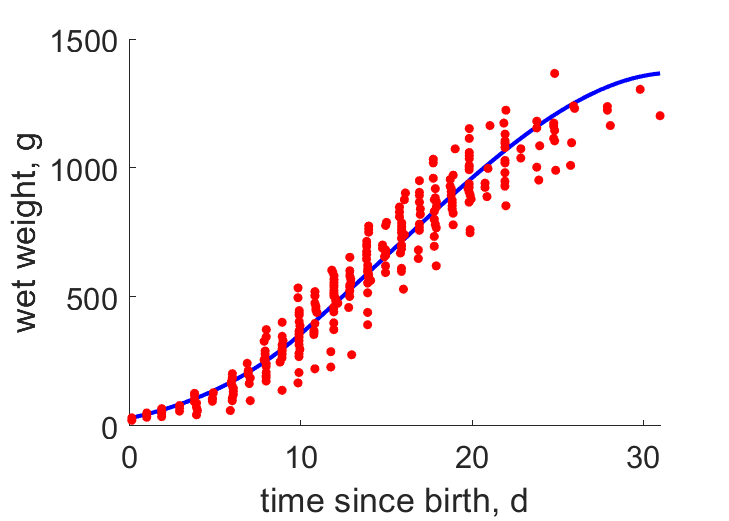 | time since birth | wet weight | (0.1067) | KalmBeck2005 |
Pseudo-data at Tref = 20°C
| Data | Generalised animal | Nannopterum brasilianum | Unit | Description |
|---|---|---|---|---|
| v | 0.02 | 0.03015 | cm/d | energy conductance |
| p_M | 18 | 602.2 | J/d.cm^3 | vol-spec som maint |
| k_J | 0.002 | 0.002 | 1/d | maturity maint rate coefficient |
| k | 0.3 | 0.02428 | - | maintenance ratio |
| kap | 0.8 | 0.9934 | - | allocation fraction to soma |
| kap_G | 0.8 | 0.8011 | - | growth efficiency |
| kap_R | 0.95 | 0.95 | - | reproduction efficiency |
| s_s | 0.01 | 0.001682 | - | supply stress |
Discussion
- Feeding is reduced just after hatch
- mod_1: Data set tp and parameter t_R are added, the latter replacing clutch interval t_N. Postnatal T is based on PrinPres1991, see get_T_Aves. See further the revision page, theme puberty
Bibliography