Predictions & Data for this entry
| Model: std | climate: MC | migrate: Ms | phylum: |
| COMPLETE = 2.5 | ecozone: MAN | food: biCvf | class: |
| MRE = 0.019 | habitat: xiMcp, 0bTd | gender: Dg | order: |
| SMSE = 0.002 | embryo: Tncfm | reprod: O | family: |
Zero-variate data
| Data | Observed | Predicted | (RE) | Unit | Description | Reference |
|---|---|---|---|---|---|---|
| ab | 31 | 31.48 | (0.01537) | d | age at birth | AnAge |
| tx | 20 | 19.96 | (0.001781) | d | time since birth at fledging | Wiki |
| tp | 60 | 59.93 | (0.001098) | d | time since birth at puberty | guess |
| tR | 1862 | 1862 | ( 0) | d | time since birth at 1st brood | AnAge |
| am | 1.562e+04 | 1.605e+04 | (0.02755) | d | life span | AnAge |
| Wwb | 70.4 | 70.74 | (0.004898) | g | wet weight at birth | MahoThre1981 |
| Wwi | 992 | 992.6 | (0.0005993) | g | ultimate wet weight | AnAge |
| Ri | 0.00274 | 0.00273 | (0.003685) | #/d | maximum reprod rate | AnAge |
Uni- and bivariate data
| Data | Figure | Independent variable | Dependent variable | (RE) | Reference |
|---|---|---|---|---|---|
| tW | 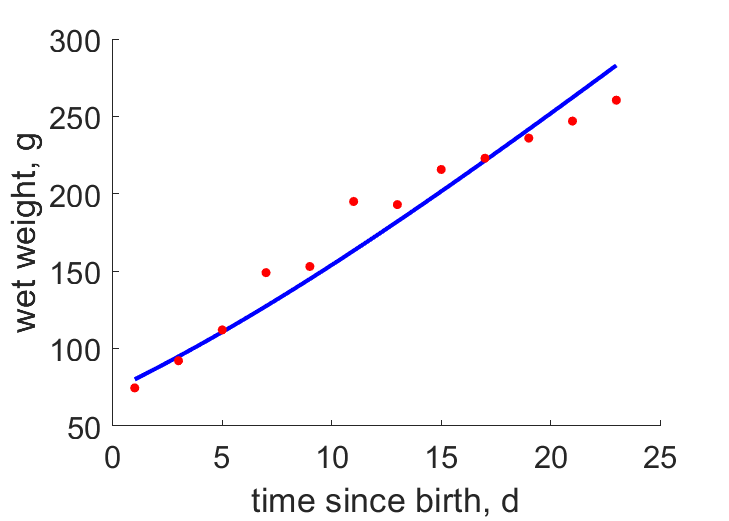 | time since birth | wet weight | (0.06564) | MahoThre1981 |
Pseudo-data at Tref = 20°C
| Data | Generalised animal | Uria aalge | Unit | Description |
|---|---|---|---|---|
| v | 0.02 | 0.0262 | cm/d | energy conductance |
| p_M | 18 | 2111 | J/d.cm^3 | vol-spec som maint |
| k_J | 0.002 | 0.08623 | 1/d | maturity maint rate coefficient |
| k | 0.3 | 0.2991 | - | maintenance ratio |
| kap | 0.8 | 0.9895 | - | allocation fraction to soma |
| kap_G | 0.8 | 0.7999 | - | growth efficiency |
| kap_R | 0.95 | 0.95 | - | reproduction efficiency |
Discussion
- Kooy2010 used the tW data to reconstruct body temperature. The present analysis assumes constant body temperature and accounts for ultimate weight Wwi, which affects predicted weights
- mod_1: v is reduced
- mod_2: Pseudo-data point k is used, rather than k_J; Data set tp and parameter t_R are added, the latter replacing clutch interval t_N. Postnatal T is based on PrinPres1991, see get_T_Aves. See further the revision page, theme puberty
Acknowledgment
- The creation of this entry was supported by the Norwegian Science Council (NFR 255295)
Bibliography